
A Heart of Generosity, and Tithing
If I start this off by saying, ‘this is a difficult topic to write on’, I worry I will be parroting every pastor and inspirational speaker who begins talking about money and tithing, particularly when the intent of those conversations is then to get the listener to give more, do more, be generous under specific circumstances.
I am not aware of any specific church that this topic currently or directly applies to. Nor can I think of any close relationship where this topic would be better to have in person. My intent is not to name and shame or coerce people into a behaviour that benefits me.
And rather than humble-bragging about the generosity I’ve shown in life, cherry-picking examples that make me sound like a saint, I’m going to put on my journalism hat, trying to be as centrist as possible and provide some options to think about critically. This is as much a thought-provoking exercise for me as it is providing a viewpoint on the topic under recent circumstances.
To begin, I’m looking back at some experiences I’ve had that relate to this topic and comparing them to the here and now.

Let me start with the context for those who may be unaware: I live in Alberta, Canada. This past year, the current provincial government has opened up polarizing conversations on topics ranging from which people ought to have their human rights honoured, to treatment of immigrants, to who is going to pay for xyz, all while handing off criticism to minorities, the federal government, and the opposition party in Alberta.
It’s easy for me to feel disheartened in this current political landscape. It’s alarming when leaders shift blame and refuse to be accountable. It’s even more alarming to see people who say they follow Jesus quickly slide into racist, individualistic, and ungenerous rhetoric because of politics.
The news, conversations, and social media posts I’m surrounded by remind me of a question I overheard in 2021.
“Why do I have to pay into EI if I never benefit from it?”
This question was asked and discussed by members of the Church during the COVID crisis, when CERB (a Canadian unemployment benefit rolled out during that time) was used by people who’d lost jobs during the pandemic. As an unprecedented event, people in leadership positions didn’t know what to do. The implementation of the benefit wasn’t perfect; information on qualifications and repayment wasn’t initially addressed, and as is the case with many benefits, abuse of the system occurred by individuals and employers. That said, hearing believers of the Gospel asking why they should pay taxes for a benefit that they weren’t using but others needed was shocking. The intent and underlying discussion of that question suggests a greed and inner attitude akin to the prosperity gospel, where there’s an expectation and belief that ‘I deserve good things because I did this, that, and the other’.
Unfortunately, a similar question is being asked in my province, and again voiced by people who say they love God and love people.
“Why do we pay taxes to the federal government only for it to be given to other provinces?”
“Why am I supporting lazy immigrants?”
“Why should I pay for people who abuse the system?”
I feel heartbroken by those statements. I want to argue and spew facts and feelings, but I know that doesn’t always - if ever - result in discussion. In the age of AI and information bubbles, it’s easy to become indignant and surround oneself with information that feeds the confirmation biases we swing towards.
Instead, let me ask us: Why do you give? Why do you tithe?

Why do you give?
Why do you tithe?
Asking this question on social media, the responses I received ranged from ‘helping others’ to ‘supporting things I care about’. Not one response was about getting some reward back.
Yet, after digging through statistics on giving in Canada, there are some less encouraging numbers signifying the motives behind our acts of generosity and worship.
Statistically, Canadians have been giving less time and money to charitable organizations every year since the 90s.
Of note, Canadians’ donations have declined by roughly $3 million since 2018. Over the past decade, the percentage of Canadians who give donations has dropped from 82% to 54%. The percentage of Canadians who volunteer for nonprofits and charities also dropped from 41% in 2018 to 32% in 2023.
One of the questions asked in the General Social Survey on Giving, Volunteering, and Participating was, ‘What is your motivation for donating?’ In Canada, 36% of religious donors said the tax credit was important to their donation decisions compared to 25% of non-religious donors. In Alberta, these numbers jumped to 39% and 27% respectfully.
According to the ‘Canadian Knowledge Hub for Giving and Volunteering’, where these numbers were found, “[Religious donors] are comparatively likely to donate in order to make a contribution to the community and because they will receive tax credits in return for donating.”
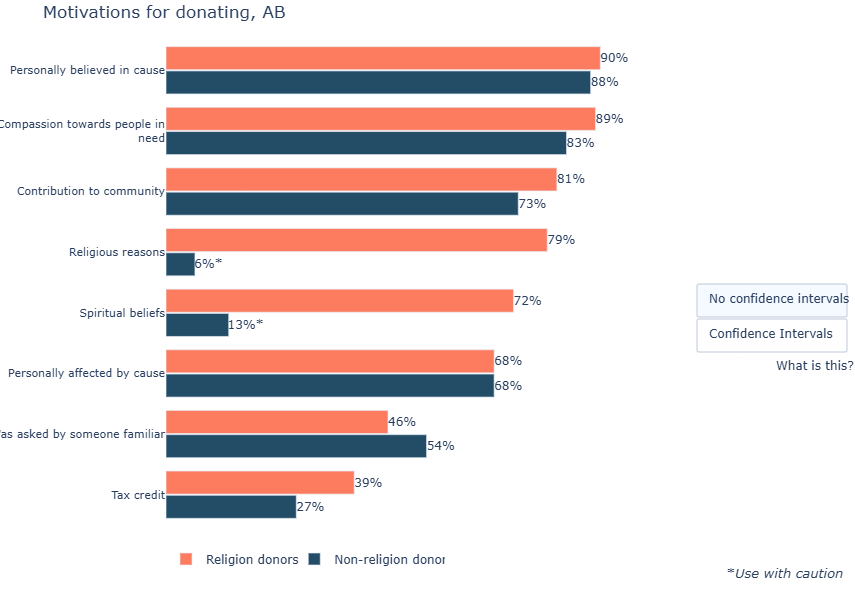
If we Christians look no differently than the world, where we give because we’ll receive tax credits, and where our motives are for our own gain, then we need to re-evaluate why we tithe and why we give.
Perhaps participants answered this question seeing it as an added bonus, or another point to check off on while filling out the census and surveys. But based on the conversations I’ve overheard, this is not a small issue occurring with one person; this is a systemic belief. What do I get out of this?
But generosity and tithing are different, you might argue. Giving to a charity is different from someone giving ten percent to God, you say.
Context is key
Let’s break down what tithing is and how it is an act of generosity.
If you are unfamiliar with the term ‘tithe’, it is a general practice by the Judeo-Christian religion of giving ten percent of one’s income towards God, often through the Church.
The first account of someone offering a tithe is in Genesis 14, where Abram is blessed by King Malchizedek, priest of God Most High and Abram responds to the blessing by giving him one-tenth of everything, based upon a promise he made to the Lord to not take ‘a thread or sandal strap or anything that is [King Malchizedek’s]’ (Gen 14:23).
The second mention of tithing occurs in Genesis 28 when Jacob has a dream and sets up the stone upon which he lay his head. “This stone, which I have set up for a pillar, shall be God’s house, and of all that you give me I will surely give one-tenth to you” (Gen 28:22).
Most people familiar with tithing think of the commands in Leviticus where the Israelites are instructed to practice giving. The tithes in the Old Testament context are:
The Levitical tithe, which was given to the Levites, who served as priests in the service of the temple and God, and could not own property or make a living wage.
The feast tithe was set aside for the expenses associated with celebrations and festivities recognized by the community.
The poor tithe that was given every three years served to provide for both the Levites and foreigners, orphans, and widows who could not provide for themselves.
Historically, the Israelites would put aside ten percent of the food they produced for tithing, and the priests would set aside ten percent of the portion they received, giving the best of that allocation to the Lord through giving it to Aaron.
What stands out to me is that the act of tithing was set up to allow God’s followers to love the Lord and love people, a beautiful summary of the ten commandments. The tithe was to provide nourishment and sustainability to the Levites, the poor, and the community in a different means of worship than sacrifices and atonements. I believe this was a practice that taught God’s people to be generous, to think of others as they could see where that offering went, and they could see the impact that it had on those who benefited from it.

The act of tithing was set up to allow God’s followers to love the Lord and love people, a beautiful summary of the ten commandments.
There’s a humbleness and awareness that was adopted in the practice of offering the ten percent of produce the Israelites kept from Leviticus through Numbers, Deuteronomy and 2 Chronicles.
Interestingly, in Malachi, God’s people are warned against their conduct and heart posture in their worship of God and their treatment of people as they ‘violated the covenant with Levi’, and defrauded labourers of their wages, oppressed widows and orphans, and deprived the foreigners among them of justice, not fearing the Lord. They had robbed the Lord of tithes and offerings.
Four hundred years later, Jesus similarly warns the Pharisees for their views and practice of giving, saying, “For you tithe mint and rue and herbs of all kinds and neglect justice and love of God; it is these you ought to have practiced, without neglecting the others” (Luke 11:42). Jesus calls the Pharisees out for being meticulous in their tithing of even herbs, but not out of a place of caring for people or honouring God.
In further context and in addition to the ten percent of produce given in tithing, Israelites would give monetarily to the temple, which is where we read of Jesus praising the poor woman donating all that she had in the form of two copper coins, compared to the large amounts that wealthier individuals made a show of giving. Her intent was to honour the Lord, not to gain status or worldly wealth, which is why Jesus honoured her.
From these two examples, I must wonder if I am either too religious in my giving or too proud.
Some further research
Before I dive into how the biblical means of tithing and giving relates to where we now approach these practices differently. I wanted to learn what tithing looks like in the modern Jewish context.
When the temple was destroyed, tithing changed. No longer was ten percent of food set aside. Instead, the practice shifted to what’s regularly done today, where people in the Jewish faith typically give a minimum of ten percent of their income to charities directly, on top of paying a membership fee to the temple they belong to, which supports the programming, staffing, and operating expenses of their local synagogue.
Most temples and synagogues do not have an offering plate, as that would contradict the commands regarding handling money on Shabbat.
In learning of these practices by Jews and Messianic Jews, I thought of the question which others have asked before me: why can’t I give directly to charities as my act of tithing?
There’s no harm in donating directly to charities. In my opinion, that’s a wonderful practice to have. However, Christian churches do not have a membership fee set up in a way that’s similar to temples and synagogues. The tithe that is offered in church settings covers the salaries of pastors and staff, the operating fees, the programs, and it covers the charitable work churches are tasked with, which includes providing support for refugees and immigrants, the poor, and people with broken families.

But this brings a question of ‘does my money go towards the things it should?’
I have two answers.
In Acts 4, Luke outlines the practice of trusting the apostles in the early Church with the proceeds given for selling property, similarly to the early Israelites trusting the priests with the tithes they brought. I think it is the responsibility of those assigned the role of delegating tithes and offerings to do so with integrity, honesty and humility. Most churches offer financial statements to show members where the money goes, which offers transparency without micromanagement.
If the church you belong to does not offer financial statements or you are aware that portions of tithes given are going towards questionable purchases, I’d humbly suggest that we not tithe to that church or organization either for that season or at all. Questionable expenses would include purchasing things like private jets, expensive vacations at the cost of the organization, unnecessary food and beverage purchases, buying expensive equipment to put on a ‘show’ for services, or even giving ‘donations’ towards things that may actually or perceptively be a conflict of interest for a pastor or staff member or their family’s benefit.
Christians, just as the motive for giving towards God needs to be in alignment with His heart, the motives and actions of those who delegate the use of those offerings need to be in alignment with God’s character and commands.
This brings me back to these two questions: why do I pay into these taxes and benefits? And how does this relate to generosity and tithing?
Today, in Canada, the task of providing for the ‘least of these’ is given both to charities and churches, and to the government. We, as taxpayers, are giving towards the support of others through those taxes. True, while we may not use those benefits directly, the position of our hearts in paying taxes and in tithing should not be one of frustration and greed. We are instructed to be cheerful givers (2 Cor 9:6-11).
Jesus himself addresses this when confronted by the Pharisees and Herodians and asked if it was right to pay the imperial tax to Caesar. Jesus' response amazed those who heard it.
“Whose image is on the coin?” Jesus said.
“Caesar’s.”
“So give to Caesar what is Caesar’s, and to God what is God’s”.
This imperial tax was a poll tax and the coin needed to pay the cost represented a full day’s wages. This tax was seen as unfair and insulting to the Jewish people, and it did not go towards supporting the marginalized.
If Jesus could tell the people with him to pay this burdensome tax, then I think it ought to be easier for us to pay taxes that go towards supporting people who need the benefits these taxes give them to have a standard of living equal to our own.

“So give to Caesar what is Caesar’s, and to God what is God’s.”
Final thoughts
The topic of money is a complicated one when we look at historical contexts compared to current ones, but one theme broken into three parts should still be consistent from then to now. No matter how I think through giving and tithing, the best way to practice those acts is through humility.
Everything we have, including the lives we live are God’s. The very least we can do is give back even a portion of our wealth.
Giving is for the benefit of others. It is a way to provide for others, to love people as God loved us and instructed us to do.
Our motives for giving or receiving should not be based on our egos. If we give for the tax breaks, the recognition, the feeling of pride, we need to re-evaluate why we are giving and what we are giving.
May we be encouraged and challenged to be generous, giving what we’ve decided in our hearts without manipulation, and with humility.
